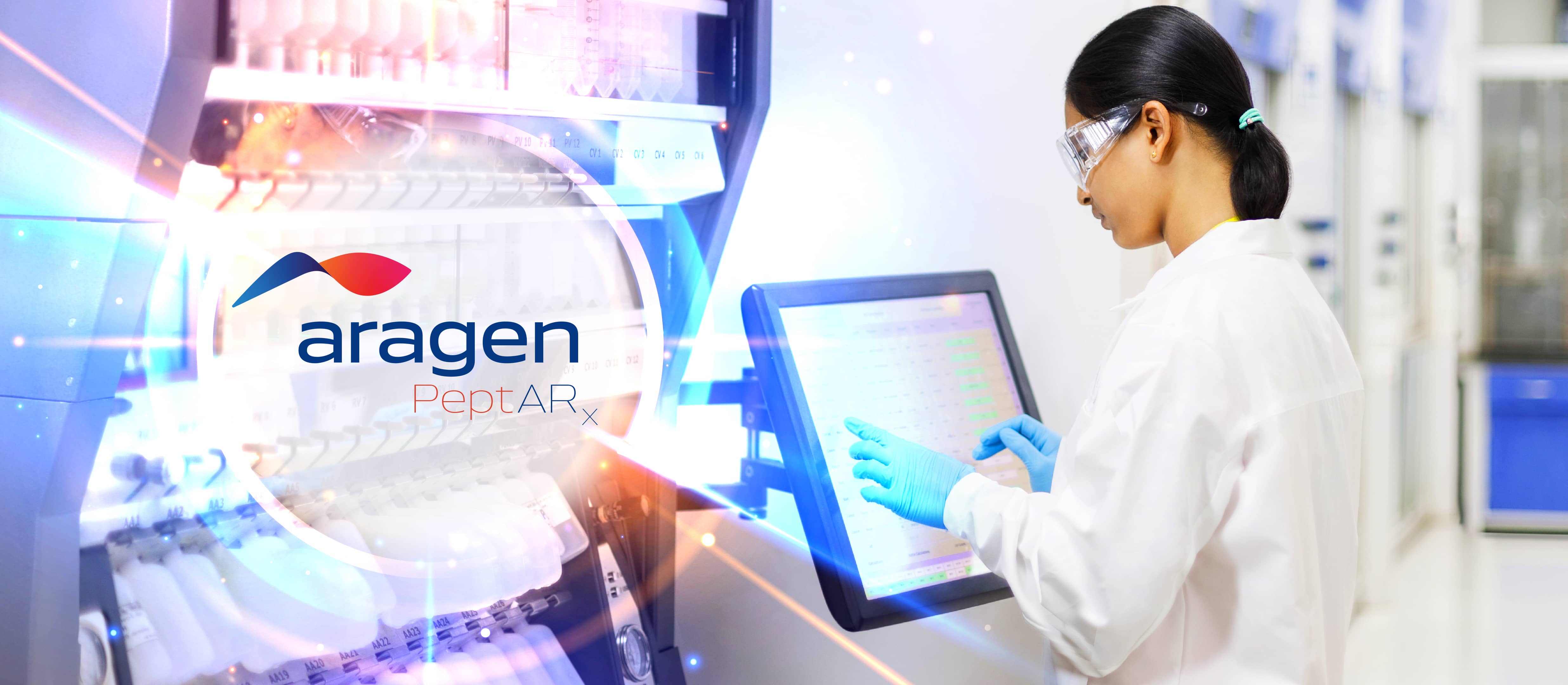
With 10+ years of dedicated peptide chemistry experience, PeptARx is Aragen’s integrated platform that helps innovators move peptide therapeutics from concept to preclinical scale—confidently and efficiently. 90 peptide scientists and 40 analytical experts in Hyderabad support you end-to-end: design, synthesis, modification, purification, and largescale non-GMP production.
Library Synthesis Tooling: 48 station SiliCycle block; orbital shakers, centrifuges, manual setups.
Scale Range: Milligram to >500 g (non-GMP), scalable to kilograms; pseudoproline dipeptides & solubility tags for difficult sequences.
Analytical & Purification
Techniques: LCMS/HRMS, HPLC, ¹H NMR; water content, residual solvents, heavy metals, counterions; inprocess LCMS/HPLC after coupling steps.
Prep HPLC: Flow rates up to 300 mL/min; DAC/SAC hardware (30–100 mm ID), packed inhouse; 10+ column chemistries (Sunfire C18, Aeris Peptide XBC18, XBridge, Jupiter C18, Capcell Pak, BEH, Proteonavi, and more).
Purification Range: 1,000–20,000 Da; outputs from mg to g, 24/7 support.
We apply late-stage functionalization techniques in PeptARx such as desulfurization, S-arylation, and double-lactam bridge formation, enabling precise tuning of peptide properties for therapeutic applications. Modifying peptides for augmented bioavailability, stability, and receptor specificity can optimize their therapeutic potential. Whether it’s improving cellular uptake, increasing half-life, or enabling targeted delivery, our modifications help make peptides more effective and versatile in their application.
Peptide Solutions for Every Application
At Aragen, we specialize in synthesizing a diverse portfolio of peptide classes, each engineered for specific therapeutic and diagnostic applications. Our expertise ensures you have access to the exact peptide tools required to investigate novel targets, explore unique mechanisms of action, and optimize delivery strategies for your research and development goals.
Peptide Type
Features & Applications
Cyclic Peptides
Increased enzymatic stability and receptor affinity, ideal for drug discovery and peptide vaccines
Disulfide-Bridged Peptides
Structural stability and mimicking protein loops for targeting intracellular proteins and receptors
Stapled Peptides
Enhanced α-helicity, protease resistance, and cell penetration for intracellular targeting
Bi-cyclic Peptides
High binding specificity and metabolic stability for use in diagnostics, imaging, and therapeutics
Boronic Acid Peptides
Reversible binding to diols for sensing applications, proteasome inhibition, and controlled delivery
Glycopeptides
Carbohydrate-modified peptides for immune modulation, receptor selectivity, and diagnostic purposes; synthesized using advanced linkers like 4-(hydroxymethyl)phenol
DOTA-Derivatized Peptides
Radiolabeling-ready scaffolds for imaging and targeted therapy
Fluorescent/Tagged Peptides
Chromophore and fluorophore additions for visualization, molecular tracking, and real-time imaging; successfully conjugated at >1 g scale with >97% purity
Synthetic Protein Fragments
Long peptides (>150 AAs) synthesized via NCL/KAHA for structure-function studies and drug targets
PeptARx Infrastructure for Synthesis & Scale-Up
Our state-of-the-art synthesis platforms and scale-up capabilities within PeptARx enable us to support projects from early-stage discovery to large-scale production.
Automated Synthesis Platforms
Small to medium scale: CEM-MultiPep 2, CEM Liberty Blue 2.0, Biotage Alstra, SYMPHONY® X-24, PTI Prelude
Scale-up reactors: SONATA®/XT, 10L jacketed reactors for solid- and solution-phase synthesis
Library synthesis: 48-station SiliCycle block, orbital shakers, centrifuges, manual setups
Scale Range
From milligrams to >500 g (non-GMP), scalable to kilograms
Crude to final purities >98%; single impurity <0.5% achievable
Pseudoproline dipeptides and solubility tags used for difficult sequences
Our scalable systems in PeptARx, from small-scale R&D to larger preclinical supply, minimize the risk of technology transfer and provide flexibility across stages of discovery and development. Whether you’re progressing from the lab to IND-enabling studies or moving toward commercialization, PeptARx helps facilitate each stage with reliable output and consistency.
Analytical & Purification Capabilities
Ensuring the purity and identity of your peptides is paramount, and our advanced analytical techniques and purification infrastructure are designed to meet those needs.
Analytical Techniques
Purity and identity verification: LCMS, HRMS, HPLC, ¹H NMR
Quality assurance: Water content, residual solvent, heavy metal, and counterion analysis
Process control: In-process LCMS/HPLC checks after amino acid coupling steps
Infrastructure & Columns
Prep HPLC: Systems with flow rates up to 300 mL/min
Column hardware: DAC and SAC, 30–100 mm ID, packed in-house
Diverse chemistries: Over 10 column options including Sunfire C18, Aeris Peptide XB-C18, XBridge, Jupiter C18, Capcell Pak, BEH, Proteonavi, and more
Purification Range
Peptides from 1,000 Da to 20,000 Da
Output: Milligram to gram quantities with 24/7 support
With these resources available in PeptARx, you gain rapid method development, consistent quality control, and the confidence that your peptides meet the highest standards of purity—essential for advancing your projects toward clinical testing.
Resins & Reagents
We utilize a broad array of resins and coupling reagents within PeptARx to ensure optimized peptide synthesis. The right resin and reagent choice significantly impacts yield, purity, and functionalization.
Resins In Routine Use
Wang (polystyrene and Chemmatrix), Rink Amide (AM, MBHA), Sieber Amide, Tentagel, 2-Cl CTC, Ramage, Dbz, Sulfamylbutyryl
Specialized for C-terminal amides, protected peptides, aldehydes, thioesters, and aggregation-prone sequences
Coupling Reagents
DIC, HATU, HBTU, COMU, PyBOP, PyAOP, DEPBT, EEDQ
The strategic selection of resins and reagents tailored for your specific peptide sequences within PeptARx ensures the optimization of synthesis, leading to higher purity, more efficient yields, and reliable outcomes even for complex, challenging peptides.