
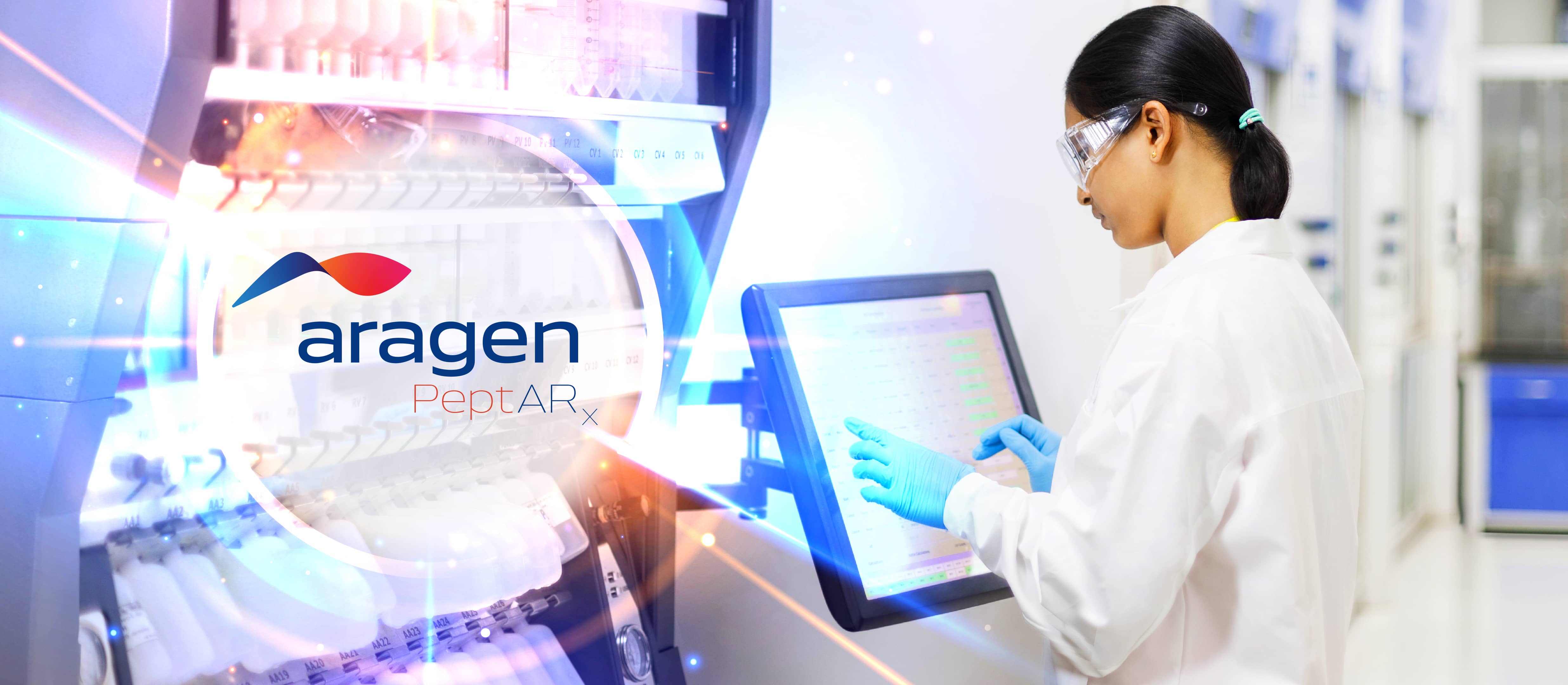
Peptide Platform
Innovating Complexity. Scaling Precision. Empowering Discovery.
PeptARx integrates peptide chemistry, assay development & screening, and DMPK into a single discovery workflow — so you know within weeks, not months, whether your candidate has a viable path forward. With 120 peptide scientists and 40 analytical experts in Hyderabad, we support you end-to-end: design, synthesis, modification, purification, biological screening, ADME profiling, and large-scale non-GMP production.
Most peptide programs fail at formulation — not at synthesis.
The biggest challenge with peptides is that they fail at the formulation level. Solubility issues. Stability concerns. Characterisation problems that surface after months of synthesis and biological testing — by which point you have invested significant time and budget into a molecule that may never become a drug.
The root cause is not poor chemistry. It is a fragmented workflow. When synthesis runs in isolation from DMPK and biological screening, problems surface late. PeptARx was designed to eliminate this disconnect: our 120 peptide scientists work alongside 75 ADS scientists and a 109-person DMPK team — all at one site. When we synthesise your peptide, we simultaneously assess its solubility, metabolic stability, permeability, and target engagement.
Chemistry. Assay Development. DMPK.
Each discipline informs the others in real time — compressing your DMTA cycle from months to weeks.
120 dedicated scientists operating the broadest synthesis technology base of any India-based peptide CRO — solid phase, liquid phase, hybrid, TAG-assisted, and native chemical ligation.
- Linear, branched, cyclic, stapled & macrocyclic peptides
- Conformationally constrained designs (on-resin & off-resin)
- Click chemistry, multiple disulfides, lactams
- Peptide conjugates (lipid, steroid, SM, carbohydrate, PEG)
- Fmoc, Z- & t-Boc chemistry types
- Protein synthesis via NCL and KAHA ligation
- Difficult peptides via solubility tags
- 2–150 amino acids, mg to kg scale, >98% purity
- 500+ unnatural amino acid building blocks in stock
- 40 dedicated analytical scientists + 24×7 purification
- Automated: PTI Prelude, CEM Liberty Blue, Biotage Alstra, SONATA XT
75 scientists with 500+ validated assays, running peptide-specific biochemical, cellular, and mechanistic screens in parallel with synthesis — so you never wait for biology data.
- Fluorescence Polarisation competitive displacement for peptide binding
- Surface Plasmon Resonance (Biacore 8K+) for kinetic characterisation
- AlphaScreen, TR-FRET/HTRF, luminescence biochemical assays
- Cell-based assays: reporter lines, cancer lines, PBMCs, primary cells
- High Content Imaging (Operetta CLS) for phenotypic screening
- Automated Patch Clamp (QPatch II 48) for ion channel targets
- Peptide degradation assays (Jess) — 80 compounds/month
- Biomarker modulation, target engagement, PD assays (in vitro & ex vivo)
- Biomek i7 & Echo 550/650 automated liquid handling for HTS
- 800+ active proteins & engineered cell lines generated
109-person DMPK team delivering peptide-relevant ADME, PK, and bioanalysis with under 7-day turnaround — one of the fastest in the CRO industry. No bottlenecks in bioanalysis.
- 1,300 PK studies / 12,000 ADME studies / 300,000 bioanalysis per month
- Solubility: pION, kinetic, thermodynamic, FaSSIF/FeSSIF/FaSSGF
- Permeability: PAMPA (GIT, BBB, skin), Caco-2, MDCK, MDCK-MDR1
- Metabolic stability: microsomes & hepatocytes across 5 species
- CYP inhibition (8 isoforms), CYP induction, TDI/MDI/DDI studies
- Plasma protein binding, blood partitioning, plasma stability
- ABC/SLC transporter assays in transfected cell lines
- In vivo PK in rodent and non-rodent species
- Biomek i7 automation: 150 compounds/assay (3× manual throughput)
- RAPID FIRE MS/MS for ultra-fast bioanalysis (5-day assay-to-report)
- XLRATE platform for real-time data transparency
- Consultative approach: study design through data interpretation
The hooks that matter to your peptide program.
Most CROs can synthesise your peptide. The question is whether they can tell you — early — if it will ever become a drug.
- 01
Formulation-Aware Peptide Chemistry
We do not just make peptides — we flag solubility, stability, and druggability issues during the synthesis phase itself. If your candidate will not formulate, you know in weeks, not months.
- 02
Integrated DMTA Cycle Under One Roof
Chemistry, ADS, and DMPK scientists sit in the same building, share data in real time, and iterate within days. No vendor handoffs. No data transfer delays. One team that sees the full picture.
- 03
Complex Peptides That Others Cannot Make
Solid phase, liquid phase, hybrid, TAG-assisted, and native chemical ligation — all on one platform. 500+ unnatural amino acids. Macrocyclic, stapled, and multi-disulfide designs from mg to kg scale.
- 04
India-Based, IP-Secure, Zero Geopolitical Risk
23 years of drug discovery partnership. 400+ customers. 90%+ repeat rate. Frost & Sullivan 2024 Global Customer Value Leadership Award. No BIOSECURE Act exposure. Up to 60% cost advantage.
Peptide discovery across the therapeutic areas that matter most.

Metabolic Disease & GLP-1
From semaglutide analogues to next-gen triple agonists. Biosafety team has run studies on 20+ GLP-1 molecules. Peptide synthesis to GLP Tox under one roof.

Oncology & PDCs
Peptide-drug conjugates targeting tumour-specific receptors. 500+ FTEs on oncology. Validated in vivo disease models. Integrated chemistry-biology workflow.

Immunology & Beyond
Cyclic and stapled peptides for intracellular targets. Macrocyclic designs expanding druggable space. CNS, cardiovascular, and infectious disease programs.
The proof behind the platform.
The Aragen Advantage
Unlike standalone synthesis providers (Bachem, PolyPeptide) who cannot offer biology or DMPK, and generalist CROs who lack peptide-specific expertise, PeptARx is the only integrated peptide discovery platform combining chemistry + ADS + DMPK under one roof — from an IP-secure India base with no BIOSECURE Act exposure.
Peptide Drug Discovery: Questions Our Clients Ask
Answers to the most common questions from pharma and biotech teams evaluating peptide CRO partners.
Most large peptide CDMOs — including Bachem, PolyPeptide, and CordenPharma — focus exclusively on manufacturing and do not offer discovery biology, assay development, or DMPK services. This means that after they synthesise your peptide, you need to engage separate vendors for biological screening and ADME profiling, creating fragmented workflows and delayed decision-making.
PeptARx is fundamentally different. It integrates peptide chemistry (120 scientists), assay development & screening (75 scientists, 500+ validated assays), and DMPK (109-person team, <7-day turnaround) into a single discovery workflow at one site in Hyderabad. This means your synthesis, biological characterisation, and pharmacokinetic profiling run in parallel from Day 1 — compressing your DMTA cycle from months to weeks and identifying formulation failures early, before you have invested months in dead-end molecules.
PeptARx supports virtually every class of therapeutic and research-grade peptide, including:
- Linear, branched, cyclic, bi-cyclic, and stapled peptides
- Macrocyclic peptides and conformationally constrained designs (on-resin and off-resin cyclisation)
- Peptide conjugates — lipid, steroid, small molecule, carbohydrate, PEG, DOTA, fluorophore
- Peptide-drug conjugates (PDCs), peptide-PMO (PPMO), and peptide-oligonucleotide conjugates (POC)
- Long peptides and synthetic protein fragments (up to 150+ amino acids) via NCL and KAHA ligation
- Peptidomimetics and N-alkylated, β-amino acid, and glycosylated amino acid-containing sequences
We operate across all three major synthesis platforms — solid phase, liquid phase, and hybrid — using Fmoc, Z- and t-Boc chemistries. With 500+ unnatural amino acids catalogued in-house, we can incorporate non-standard building blocks without sourcing delays that add weeks to competitor timelines. Scale ranges from milligrams to >500 g (non-GMP), with purities routinely exceeding 98%.
The most common reason peptide drug candidates fail is not poor synthesis — it is poor druggability. Solubility issues, metabolic instability, low permeability, and aggregation-related problems frequently surface late in the development cycle, after months of synthesis and testing have already been completed. By that point, significant budget and time have been invested in a molecule that may never become a viable drug.
PeptARx was designed specifically to catch these failures early. Because our peptide chemists work alongside DMPK scientists (who assess solubility, metabolic stability, permeability, and plasma stability) and ADS scientists (who run target engagement and functional assays) at the same site and within the same project team, we can flag formulation-level problems during the synthesis phase itself. This "formulation-aware" approach means clients know within weeks — not months — whether their candidate has a viable path forward, saving both time and development budget.
Peptide candidates require specialised ADME assessment that differs from standard small-molecule protocols. Applying conventional small-molecule DMPK methodologies to peptides often generates misleading results — a common pitfall when synthesis and DMPK are handled by different vendors. Aragen's 109-person DMPK team delivers peptide-relevant profiling with a turnaround of under 7 working days, including:
- Solubility screening (pION, kinetic, thermodynamic, biorelevant media including FaSSIF, FeSSIF, and FaSSGF)
- Permeability assessment (PAMPA-GIT, PAMPA-BBB, Caco-2, MDCK, MDCK-MDR1)
- Metabolic stability in microsomes and hepatocytes across five species (human, mouse, rat, dog, monkey)
- Plasma protein binding, plasma stability, and whole blood partitioning
- CYP inhibition (8 isoforms), CYP induction (PXR, CAR, AHR), and transporter assays (ABC/SLC T7 panel)
- In vivo pharmacokinetics in rodent and non-rodent species
Our Biomek i7 automated workstations process 150 compounds per assay (3× manual throughput), and RAPID FIRE MS/MS enables a 5-day assay-to-report cycle — ensuring that DMPK data never becomes the bottleneck in your peptide discovery timeline.
Yes — metabolic disease and GLP-1 programs are one of PeptARx's strongest therapeutic focus areas. The GLP-1 revolution has created enormous demand for peptide synthesis and characterisation services, from semaglutide analogues to next-generation dual and triple agonists (GLP-1/GIP, GLP-1/GIP/glucagon).
What sets Aragen apart in this space is the depth of our biosafety team's experience with GLP-1 molecules. Our team has conducted bioanalytical studies on 20+ GLP-1 molecules — covering both innovator and biosimilar programs — making us one of the leaders in India for metabolic peptide safety assessment. This means we can offer a true end-to-end metabolic peptide workflow: from peptide synthesis through DMPK profiling to GLP toxicology, all under one roof. Clients do not need to transfer their program between multiple vendors at the critical transition from discovery into preclinical safety.
IP protection is paramount for peptide drug discovery, where the molecular sequence itself is often the client's most valuable asset. Aragen has maintained robust IP protection protocols across 23 years of drug discovery partnerships, serving 400+ global customers with a 90%+ repeat rate — a metric that reflects deep client trust.
Our IP protection infrastructure includes: fully digital operations with 21 CFR Part 11-compliant electronic lab notebooks (eLNB), strict documentation protocols for data integrity and confidentiality, and the InCoRe digital platform that provides real-time project transparency while maintaining data security. As a Frost & Sullivan 2024 Global Customer Value Leadership Award recipient, our quality and governance standards are independently validated.
Critically, Aragen has zero BIOSECURE Act exposure. As an India-headquartered CRDMO, our operations are not affected by the US legislation restricting collaboration with certain China-based service providers. For pharma and biotech companies currently diversifying their CRO panels away from China-based peptide providers, Aragen offers a geopolitically neutral alternative with up to 60% cost advantage versus Western CROs.
PeptARx supports the full discovery-to-preclinical scale continuum without requiring technology transfer to a separate manufacturing partner. Our scale range covers:
- Discovery scale: Milligram quantities for SAR studies, assay development, and lead identification
- Optimisation scale: Hundreds of milligrams for in vivo efficacy studies, DMPK profiling, and formulation development
- Preclinical / IND-enabling scale: >500 g batches at >98% purity (single impurity <0.5%), scalable toward kilogram quantities for toxicology studies
This is enabled by our infrastructure: automated synthesisers (CEM Liberty Blue, Biotage Alstra, PTI Prelude) for discovery scale, SONATA/XT reactors and 10L jacketed reactors for scale-up, and our 24/7 preparative HPLC purification capacity supporting peptides from 1,000 to 20,000 Da. By keeping the entire program within PeptARx — from first milligram synthesis through to IND-enabling batches — we eliminate the technology transfer risks and timeline delays that frequently occur when transitioning peptides between discovery CROs and manufacturing CDMOs.
More Insights

Running a peptide program?
A detailed overview of our peptide chemistry, assay development & screening, and DMPK capabilities — including instrumentation, team structure, therapeutic area experience, and case study highlights.
- 120 peptide scientists — team structure and expertise breakdown
- Complete synthesis technology platform (solid, liquid, hybrid, microwave, scale-up)
- 500+ assay panels with peptide-specific screening capabilities
- DMPK service menu with turnaround times and throughput data
- Automation infrastructure and analytical instrumentation list
- Therapeutic area case study highlights
- Engagement models and partnership structures

